Seasickness aboard the Charlotta
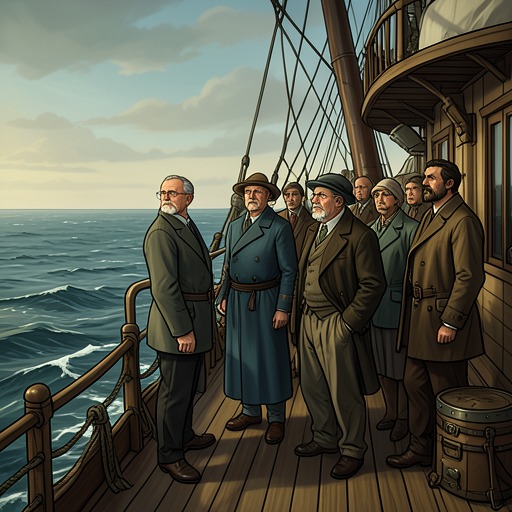
The EmigrantsSeasickness aboard the Charlotta is the bodily cost of a migration that has left land behind but has not yet brought the emigrants to a new home. The ship’s rolling makes the cramped passage physically intolerable, while its routines of rationing, cleaning, and confinement shape how passengers endure illness. Robert’s first experience of the motion opens into a collective ordeal: the vessel carries a human cargo in which nausea afflicts the converted and unconverted alike, before most passengers slowly grow accustomed to the sea.
A Ship Built for Confinement
The brig Charlotta sailed from Karlshamn for New York on April 14, 1850. It carried 78 emigrants alongside a crew of fifteen, for 94 people in all. Though 124 feet long and 20 feet wide, the ship offered little room for its passengers. Canvas divided the hold into compartments for families, unmarried men, and unmarried women; bedding, food baskets, and bundles crowded the floor, and the low overhead kept the air thick and choking. The main hatch supplied the hold’s only light, while after dark weak kerosene lanterns hung along the sides.
The ship’s arrangements made sickness harder to manage. Passengers received unprepared provisions by weekly allotment and had to take turns cooking in the galley. Each person was allowed half a gallon of fresh water daily for drinking and washing. The passengers themselves had to clean the hold each morning, removing vomit and other dirt before the day’s water was issued. Thus the routine placed the work of restoring order after a sick night before the needs of those who were thirsty or wanted to wash.
The First Onset
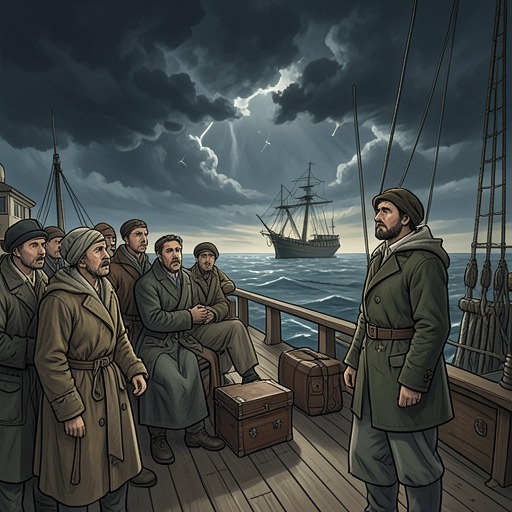
During a storm, Robert had wanted to stay on deck rather than seem cowardly. As the Charlotta listed and rolled, however, dizziness took hold and his stomach seemed to move loosely inside him. He recognized in the experience a description he had read in his History of Nature of the effect of a ship’s rolling on inexperienced travelers. Seeing that only a couple of passengers remained on deck, he realized he was not alone in retreating; he went below and lay in his bunk.
The storm also made ordinary shipboard tasks dangerous. A woman preparing her evening meal in the galley was badly scalded when a pot of boiling water fell onto her foot as the ship began to roll. From behind the sailcloth partition came both her threat to complain to the captain and a man’s angry dismissal of the women. The scene places the sickness and physical danger inside a crowded social space where passengers depended on shared facilities, yet could answer one another’s distress with resentment.
A Collective Affliction
The narrative enlarges the episode beyond any one sufferer. In the hold, which it figures as the ship’s narrow stomach, people lie packed close together, making the sounds of sickness. The ship has one stomach, the account observes, but within it are many: young and old, children and adults, healthy and sick, converted and unconverted, sinners and repenters. Seasickness levels these distinctions at the level of bodily pain. It becomes part of the storm’s human cargo, an affliction carried through the ship alongside the emigrants themselves.
The physical conditions of the voyage continue to press on the passengers even as they establish a routine. Each morning the men carry water in buckets while the women scrub, scour, wash, and hang wet clothing on deck. Drinking water remains withheld until the quarters are clean. Complaints that half a gallon is too little meet the explanation that the ship’s supply must last through a voyage that could stretch to three months in unfavorable weather. The passengers are required to conserve water and keep the hold clean while coping with the consequences of the previous night’s illness.
Adaptation and Its Limits
As the weeks pass, most of the emigrants become accustomed to the ship’s rolling. Kristina recovers from seasickness, gets up, and becomes able to eat almost regularly. But the improvement is not a return to her former health: weakness remains in her limbs, her body feels heavy, and pressure in her chest makes her breath short. Other passengers report similar complaints. The narrative therefore distinguishes growing accustomed to the motion from being restored by it; adaptation eases the immediate ordeal but does not erase the physical effects of a long stay aboard.
The crossing also turns distance into a measure of endurance. Contrary winds, currents, and fog delay the ship, and the emigrants count the passage not in miles but in the long days since they left in the second week of April. Their Swedish homeland and their hoped-for homes in North America seem at once incalculably remote. In that suspended interval, seasickness belongs to a larger condition of exposure: movement carries the emigrants forward, but the sea controls the pace, and the passengers must inhabit the crowded ship for as long as the voyage lasts.